

A financial number is the specific amount of money you need to achieve financial independence, cover your living expenses, or reach a defined financial goal such as early retirement. It acts as a clear financial target that helps you measure progress, guide investment decisions, and plan your future with confidence.
In simple terms, your financial number tells you how much money is enough to support your desired lifestyle—without relying on active income.
Whether you’re planning early retirement, building long-term wealth, or using FIRE calculators, understanding this concept is one of the most important steps in achieving financial freedom.
Why Your Financial Number Matters
Your financial number is not just a random figure—it is the foundation of your entire financial strategy.
Without a defined target, you are essentially guessing how much to save, invest, and plan for the future. This often leads to confusion, inconsistent progress, and delayed goals.
Here’s why it plays a critical role:
- Provides clarity and direction
- Helps measure progress toward independence
- Guides saving and investment decisions
- Reduces uncertainty about retirement
- Aligns your lifestyle with long-term goals
Instead of asking vague questions like “Am I saving enough?”, you shift to a more powerful mindset:
👉 “Am I on track to reach my target?”
This shift alone can transform your financial journey.
Types of Financial Numbers You Should Know
Not all financial targets are the same. Depending on your goals, you may need multiple benchmarks.
1. Financial Independence Number
This is the most commonly used target. It represents the amount of money required so that your investments generate enough income to cover your living expenses indefinitely.
2. Retirement Number
This figure focuses specifically on retirement planning. It depends on your retirement age, expected lifestyle, healthcare costs, and inflation.
3. Coast FIRE Number
This is the amount you need to invest early so your portfolio grows on its own without additional contributions. It’s ideal for reducing future savings pressure. Use a coast fire calculator to estimate how much you need today to reach your retirement goal passively.
4. Barista FIRE Number
This is a reduced target where investments cover part of your expenses while part-time income fills the gap. It offers flexibility instead of full retirement. A barista fire calculator helps you determine the right balance between investments and income.
5. Fat FIRE Number
This represents a higher target for a comfortable or luxury retirement lifestyle, including travel and premium living. A fat fire calculator helps estimate the larger portfolio required to sustain higher spending.
6. Lean FIRE Number
This is the minimum amount needed to retire early with a low-cost lifestyle focused on simplicity. A lean fire calculator helps you calculate how quickly you can achieve financial independence with lower expenses.
How to Calculate Your Financial Number
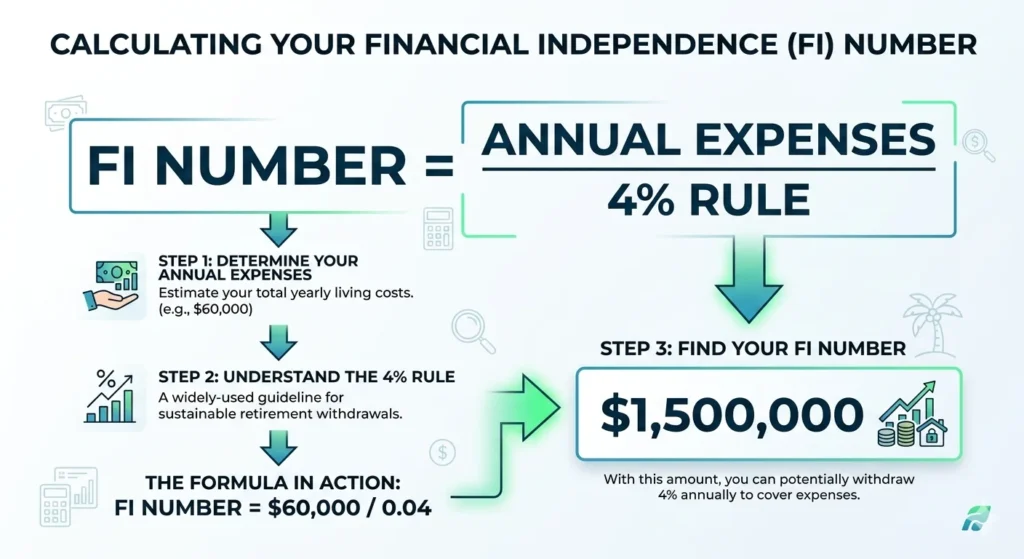
Calculating your target is simpler than most people think. The most widely used approach is based on the 4% rule.
Basic Formula
Financial Number = Annual Expenses ÷ 0.04
Example
- Annual expenses: $50,000
- Required amount: $50,000 ÷ 0.04 = $1,250,000
This means you would need approximately $1.25 million invested to sustainably generate your yearly expenses.
Why Manual Calculation Is Not Enough
While the formula is simple, real-life financial planning is not.
This is where FIRE calculators become extremely useful.
They help you:
- Adjust for inflation
- Estimate investment growth
- Simulate different scenarios
- Calculate timelines
Instead of relying on static numbers, you get dynamic projections tailored to your situation.
Financial Number in the FIRE Movement
The concept of a financial number is central to the FIRE (Financial Independence, Retire Early) movement.
How FIRE Uses Financial Numbers
FIRE strategies rely on calculating a precise financial number to determine when you can stop working.
Each FIRE variation adjusts this number:
- Lean FIRE: Lower expenses → smaller financial number
- Fat FIRE: Higher lifestyle → larger financial number
- Barista FIRE: Partial income → reduced financial number
- Coast FIRE: Early investing → delayed withdrawals
Understanding the 4% Rule
The 4% rule is one of the most popular guidelines in financial planning.
It suggests that you can withdraw 4% of your investment portfolio annually without running out of money over time.
Why It Works
- Based on historical market data
- Designed for long-term sustainability
- Adjusts withdrawals for inflation
Important Limitation
Markets are unpredictable. The rule is a guideline—not a guarantee.
That’s why combining it with calculators gives more realistic results.
Factors That Influence Your Financial Target
Your required amount is not fixed. It changes based on several key variables.
1. Lifestyle Expenses
This is the biggest factor.
- Higher spending → higher target
- Lower spending → lower target
2. Investment Returns
Better returns can reduce how much you need to invest, while lower returns increase the requirement.
3. Inflation
Over time, the cost of living rises. Ignoring this can lead to underestimating your needs.
4. Retirement Age
Retiring earlier means your money must last longer, increasing the required amount.
5. Additional Income
Side income, freelancing, or passive income can significantly reduce your required investment size.
Role in the FIRE Movement
This concept is central to the FIRE (Financial Independence, Retire Early) movement.
Each FIRE strategy adjusts the required amount based on lifestyle:
- Lean FIRE → minimal expenses
- Fat FIRE → higher lifestyle costs
- Barista FIRE → partial income model
- Coast FIRE → early investment growth
Understanding these variations helps you choose a strategy that fits your goals.
How FIRE Calculators Improve Financial Planning
Modern tools simplify complex financial decisions.
What They Do
- Estimate how long it takes to reach your goal
- Project investment growth
- Adjust for inflation
- Test multiple scenarios
Benefits
- Eliminates guesswork
- Provides data-driven insights
- Helps track progress
- Improves decision-making
They also answer critical questions like:
- How much should I invest monthly?
- When can I stop working?
- What if my income changes?
Common Mistakes to Avoid
Many people make errors when estimating their financial target.
1. Underestimating Expenses
Ignoring healthcare, travel, or lifestyle changes leads to inaccurate planning.
2. Ignoring Inflation
Future expenses are always higher than today’s.
3. Overestimating Returns
Assuming unrealistic growth can create false expectations.
4. Lack of Diversification
A poorly diversified portfolio increases risk.
5. Setting Unrealistic Goals
Your plan should match your lifestyle—not social trends.
How to Reduce Your Financial Target
If your goal feels too high, there are practical ways to lower it.
1. Reduce Expenses
Even small changes can significantly impact your target.
2. Increase Income
Higher income allows faster investing and growth.
3. Start Early
Time is your biggest advantage due to compounding.
4. Invest Consistently
Regular investing builds wealth steadily over time.
5. Build Passive Income
Income streams like dividends or rentals reduce reliance on investments.
Real-Life Example
Let’s compare two individuals:
Person A
- Expenses: $40,000/year
- Required amount: $1,000,000
Person B
- Expenses: $80,000/year
- Required amount: $2,000,000
Same strategy, but lifestyle differences double the requirement.
The Power of Compound Interest
Compound interest is the engine behind wealth building.
What It Means
Your investments generate returns, and those returns generate more returns over time.
Why It Matters
- Accelerates growth
- Reduces effort
- Rewards early investing
The earlier you start, the easier your journey becomes.
Financial Number vs Net Worth
These two are often confused.
Financial Number
- Future target
- Based on expenses
- Goal-oriented
Net Worth
- Current financial position
- Assets minus liabilities
- Snapshot of today
Your objective is to grow your net worth until it reaches your target.
Do You Need Multiple Financial Targets?
Yes, in many cases.
You may need separate numbers for:
- Emergency fund
- Retirement
- Passive income goals
- Investment milestones
Having multiple benchmarks makes your journey more structured and achievable.
How to Track Progress Effectively
Tracking is just as important as planning.
Best Practices
- Review finances monthly
- Update expenses regularly
- Adjust assumptions yearly
- Use digital tools for accuracy
Consistency is key to staying on track.
Advanced Strategy: Dynamic Financial Planning
As your life changes, your target should evolve.
Major life events like:
- Marriage
- Career changes
- Relocation
- Children
can all impact your financial needs.
Regular updates ensure your plan remains realistic and relevant.
Key Takeaways
- A financial number represents the amount needed for financial independence
- It is commonly calculated using the 4% rule
- Lifestyle, expenses, and returns heavily influence it
- Different FIRE strategies use different targets
- FIRE calculators improve accuracy and planning
- Starting early and investing consistently are critical